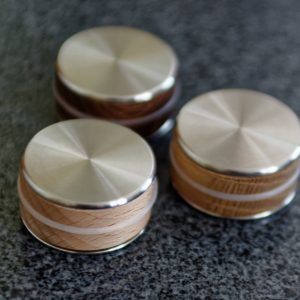
Description
A simple place
to start.
A dedicated layer beneath your audio equipment.

Support more.
Save more.
Choose the total number of pads you need. Allow four pads per component when planning your setup.
One component
€39
4 pads · approx. €9.75 per pad
Standard set price
4 pads for one component.
A simple way to start.
Two components
€69
8 pads · approx. €8.63 per pad
Save €9 · 11.5%
8 pads — two sets of four.
Only €30 more than the 4-pad set.
System set
€99
12 pads · approx. €8.25 per pad
Save €18 · 15.4%
12 pads — three sets of four.
Add four more pads for €30.
Savings compared with buying separate 4-pad sets at €39 each: 8 pads €78 → €69; 12 pads €117 → €99. Check that every contact point is fully supported and your equipment stays level.
Start at the support.
Your shelves and rack are part of your equipment’s mechanical environment.
P4TO pads are designed to reduce vibration transfer between a component and the surface beneath it.
Under the feet.
Or directly under the chassis.
Choose the arrangement that gives your equipment stable, level support. In both cases, the small feet on each P4TO pad face down towards the shelf.
For direct chassis support, check that the pads are tall enough to lift the original feet clear. Keep ventilation openings, screws and fragile panels free of pressure. Side views are schematic and not to scale.
More than a wooden pad.
Thermally treated wood
P4TO uses ring-porous wood treated by pyrolysis in oxygen-free conditions at a controlled temperature. This alters the wood’s cell-wall components, including lignin, cellulose and hemicellulose.
The treatment is intended to create a structure that dissipates mechanical vibration as heat.
Four small feet beneath each pad
The feet use a material with properties between plastic and rubber. The aim is to avoid the slippery contact of hard plastic and the spring-like behaviour of soft rubber.
The treated wood and feet work together between the equipment and its supporting surface.
Dimensions & foot construction
- Overall pad size
- 70 × 70 × 18 mm, including feet
- Wooden body thickness
- 16 mm
- Foot diameter
- 9.5 mm
- Foot thickness / recessed seat
- 4 mm / 2 mm
- Exposed height below the wood
- 2 mm
- Locating peg length
- 9 mm, inserted into the wood
See the comparison.
The final chamber test measured vibration at the metal support’s baseplate. The loudspeaker was supported on three P4TO pads or three metal feet; the metal-foot result provides the comparison baseline.
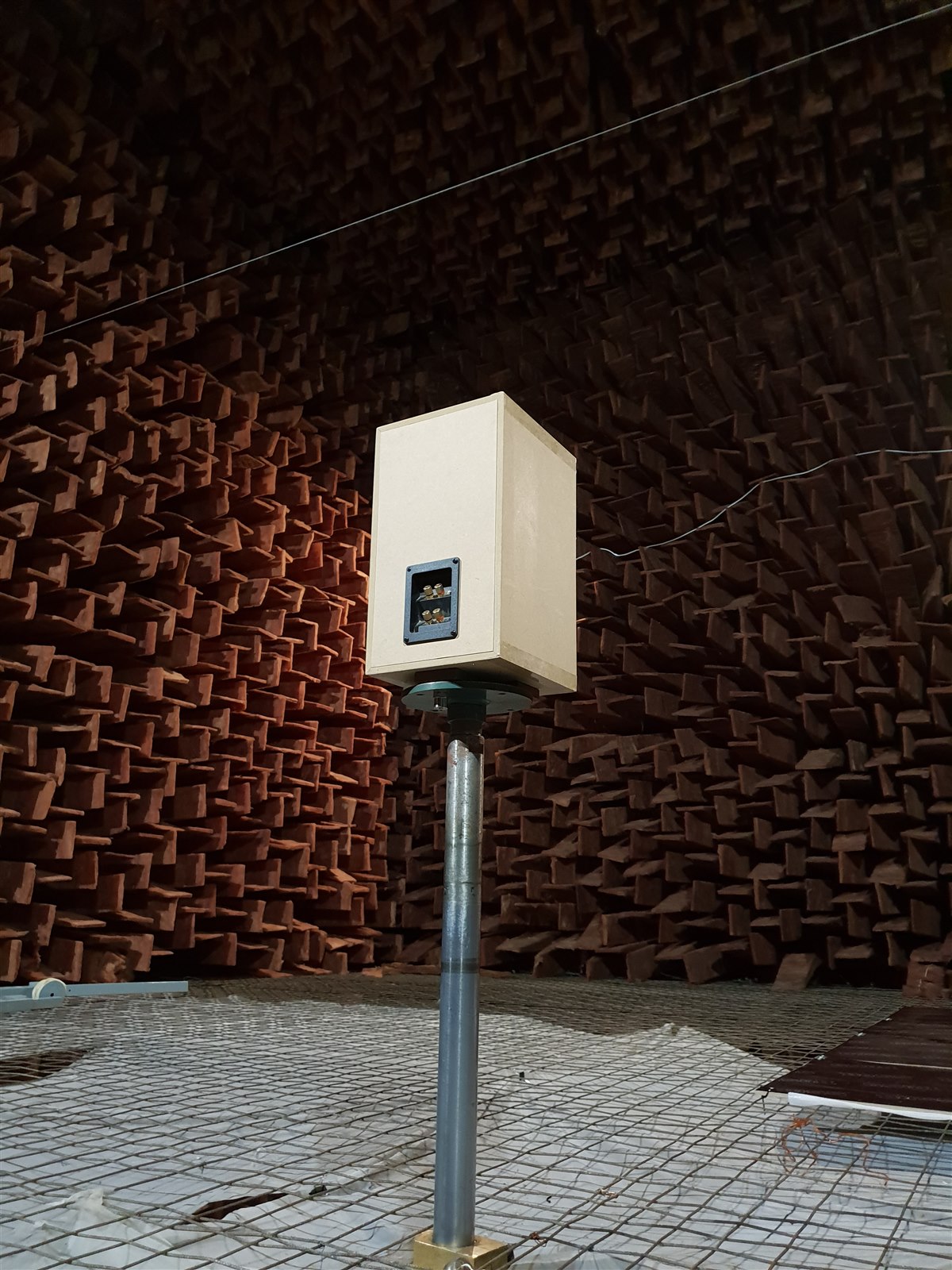
Inside the anechoic chamber.
A two-way loudspeaker was driven by an MLS (Maximum Length Sequence) test signal.
The final test used three supports of each type. A vibration sensor measured the response at the metal support’s baseplate, rather than the loudspeaker’s sound level in the room.
Photo from the laboratory measurements. Select to enlarge.
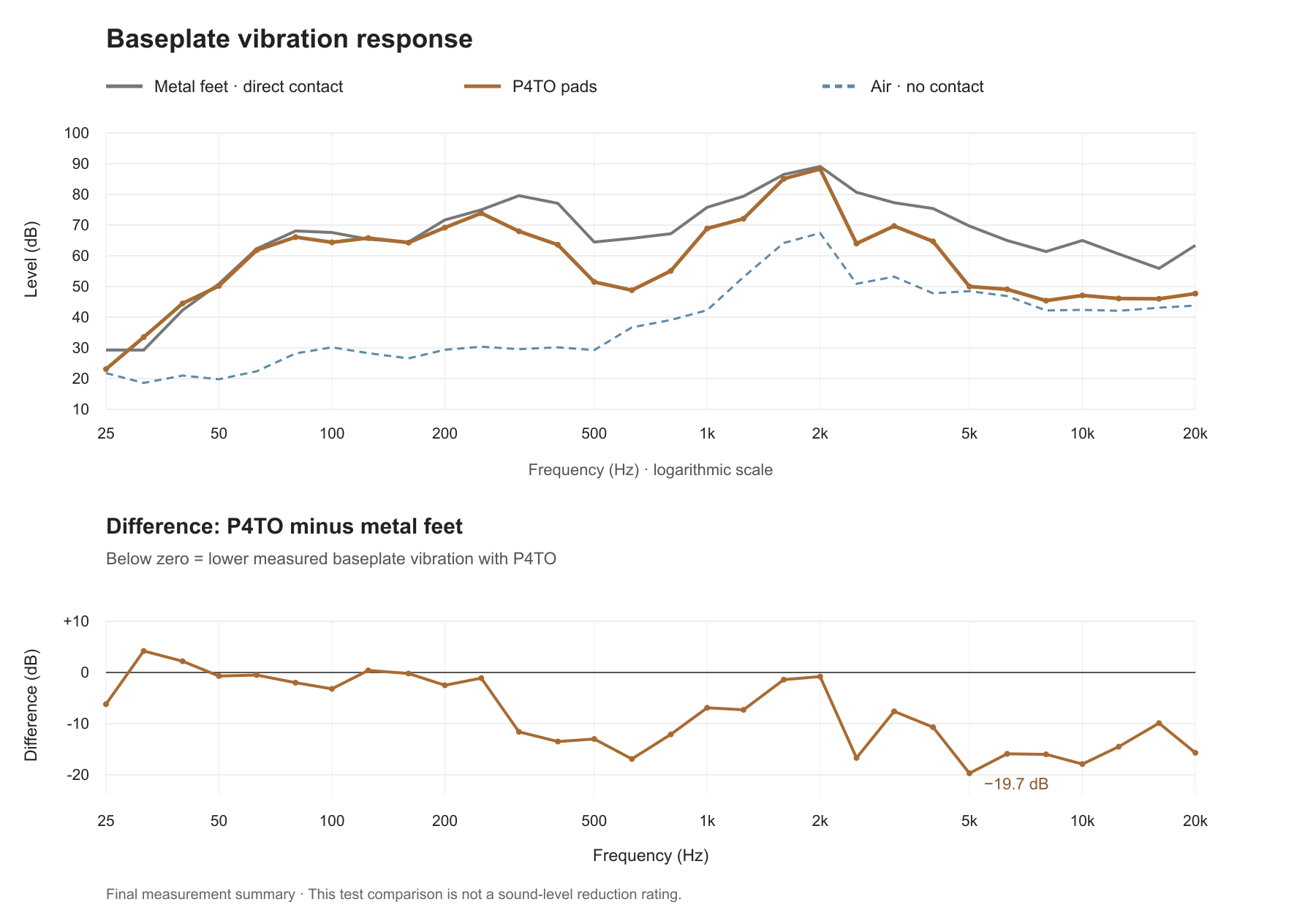
30 frequency points.
27 lower readings.
The final measurement summary covers 25 Hz to 20 kHz. P4TO gives a lower response than direct contact at 27 of the 30 measured frequency points.
The largest reduction in this comparison is 19.7 dB at 5 kHz.
| Frequency | Difference |
|---|---|
| 315 Hz | −11.6 dB |
| 630 Hz | −16.9 dB |
| 5 kHz | −19.7 dB |
| 10 kHz | −17.9 dB |
Negative values mean a lower measured baseplate vibration level with P4TO.
The response is higher at 31.5 Hz (+4.2 dB), 40 Hz (+2.2 dB) and 125 Hz (+0.4 dB). These differences describe this test setup; they are not a single isolation rating or a prediction of audible improvement in every system.
What does the dB difference mean?
The loudspeaker excites the support through its contact points. The sensor records the vibration response of the receiving baseplate. A lower reading with P4TO means less vibration at that measurement location and frequency than with metal feet.
Difference (dB) = P4TO level − metal-foot level
For example, −19.7 dB at 5 kHz describes a reduction in the measured baseplate vibration level. It does not mean that the music became 19.7 dB quieter, or establish the size of an audible improvement.
The result describes the complete test arrangement, including the loudspeaker, supports and baseplate. It is not a standalone input-to-output transmissibility measurement of the pad.
Test method & full measurement table +
Final chamber test. To minimise sound reflections from surrounding room surfaces, the final measurements were carried out in an acoustically damped chamber. The loudspeaker was placed on the chamber’s metal support using three supports of each type. MLS excitation was applied to the loudspeaker, vibration was measured at the support baseplate, and the results were compared with the metal-foot condition. The procedure describes repeated MLS bursts with approximately 30 seconds of total excitation.
Earlier development tests. The first three stages used one support of each type in office conditions. These included simultaneous measurements at the loudspeaker and table with two sensors; a probe test using continuous noise with one side of the loudspeaker supported on foam; and an MLS test on a marble slab isolated from the floor by foam. Sound acting on the receiving surface and room reflections affected these trials, so testing moved to the chamber.
All 30 measured frequencies
Difference = P4TO − metal feet. Negative values mean a lower measured vibration level. On a small screen, swipe the table sideways.
| Frequency (Hz) | P4TO (dB) | Metal feet (dB) | Difference (dB) |
|---|---|---|---|
| 25 | 23.1 | 29.3 | −6.2 |
| 31.5 | 33.5 | 29.3 | +4.2 |
| 40 | 44.5 | 42.3 | +2.2 |
| 50 | 50.2 | 50.9 | −0.7 |
| 63 | 61.8 | 62.3 | −0.5 |
| 80 | 66.1 | 68.1 | −2.0 |
| 100 | 64.4 | 67.6 | −3.2 |
| 125 | 65.8 | 65.4 | +0.4 |
| 160 | 64.3 | 64.5 | −0.2 |
| 200 | 69.2 | 71.7 | −2.5 |
| 250 | 73.9 | 75.0 | −1.1 |
| 315 | 68.0 | 79.6 | −11.6 |
| 400 | 63.6 | 77.1 | −13.5 |
| 500 | 51.5 | 64.5 | −13.0 |
| 630 | 48.8 | 65.7 | −16.9 |
| 800 | 55.1 | 67.2 | −12.1 |
| 1000 | 68.9 | 75.8 | −6.9 |
| 1250 | 72.1 | 79.4 | −7.3 |
| 1600 | 85.1 | 86.5 | −1.4 |
| 2000 | 88.3 | 89.1 | −0.8 |
| 2500 | 64.0 | 80.7 | −16.7 |
| 3150 | 69.7 | 77.3 | −7.6 |
| 4000 | 64.7 | 75.4 | −10.7 |
| 5000 | 50.0 | 69.7 | −19.7 |
| 6300 | 49.1 | 65.0 | −15.9 |
| 8000 | 45.4 | 61.4 | −16.0 |
| 10000 | 47.1 | 65.0 | −17.9 |
| 12500 | 46.1 | 60.6 | −14.5 |
| 16000 | 46.0 | 55.9 | −9.9 |
| 20000 | 47.7 | 63.4 | −15.7 |
Place. Level. Compare.
Check the fit.
70 × 70 mm per pad. Under the existing feet, the pads add 18 mm. For direct chassis support, check clearance beneath the original feet.
Keep it stable.
Fully support each contact point. Keep the equipment level and ventilation clear.
Listen in your system.
Use familiar recordings at the same volume. Results depend on equipment, placement and the support surface.
Before you choose.
What’s included? +
Choose 4, 8 or 12 Audwave P4TO vibration isolation pads. Each option states the total number of pads included.
Will the pads fit my equipment? +
Each pad measures 70 × 70 × 18 mm. Check foot dimensions, contact points and clearance. Ask us about your equipment’s weight before ordering if you are unsure.
Will I hear a difference? +
The result depends on your equipment, rack, placement and vibration environment. Compare in your own setup; an audible change is not guaranteed.