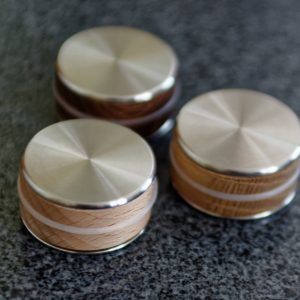
Description
AUDWAVE / REFERENCE SERIES
One system.
Different possibilities.
VI-3 Reference
Individual feet or A + B + C kit
Explore a family of audio support feet with different material combinations. Start with a simple arrangement, then refine your choice one support at a time.

01 / THE CONSTRUCTION
The materials
behind VI-3.
The existing product specification combines stainless-steel outer parts with an oak-and-elm housing. Individual models use different combinations of metals, crystals or minerals.
The VI-3 family combines a consistent outer construction with different internal material combinations. The model guide below helps you explore the individual listening characterisations.
Internal material combinations vary by model.
VI-3 / MATERIALS
Stainless steel.
Upper and lower metal parts.
Oak & elm.
A combination of natural woods.
Different materials.
Metal, crystal or mineral combinations depending on the selected model.
Materials overview · explore individual models below.
02 / YOUR STARTING POINT
Start with
A + B + C.
The original VI-3 guide recommends A, B and C as an initial three-support combination. It brings together one starting model from each listening-character group.
Establish a familiar reference first. Then change one support at a time and compare with the same music and listening level.
A + B + C kit · 3 feet · €600 total.
Final choice depends on the equipment, support surface and listening preference.
03 / THE MODEL GUIDE
Find your direction.
Choose a group, then open a model for its full original description. These are Audwave’s listening characterisations from the original guide, rather than measured frequency-response ratings.
Midrange
A · D · F · K · K2
AThe starting point+
A feet is considered one of base feet’s and when you start experimenting with feet from Group 1 it is suggested to start with A feet.
- works in midrange
- incredible gain in midrange diversity, naturalness and richness
- impressive 3D soundstage depth
- enhanced sustain of musical notes
DPresence & focus+
- works in lower highs and midrange
- ability to make more distinct vocals
- midrange emphasis but not as rich as with A feet
- less deep but more forward soundstage
FSpace & definition+
- works in midrange
- Incredible sound stage illumination and clarification effect
- very deep 3D soundstage with especially well focused central part
- enhanced sustain of musical notes
- enhanced transient speed
KRichness & clarity+
- works in lower high and midrange
- very rich but also very clear midrange
- wide and deep soundstage
- enhanced sustain of musical notes
- very high micro dynamic resolution (clarification effect)
K2A balanced alternative+
- most balanced feet equally works in all ranges (high-mid-bass) therefore can replace feet in any group
- wide soundstage
- enhanced sustain of musical notes
- very high micro dynamic resolution (clarification effect)
- better speed and music attack
Bass
C · G · E · H
CThe starting point+
C feet is considered one of base feet’s and when you start experimenting with feet from Group 2 it is suggested to start with C feet.
- works in lower mid-bass and bass region
- deep bass extension and power boost
- less deep but more forward soundstage
- leading edge transient speed emphasis
GTexture & sustain+
- works in midrange and bass region
- rich midbass emphasis
- very rich midrange spatial cues
- more textures in midrange but in some cases may be too much
- very spacious 3D soundstage
- enhanced sustain of musical notes
- enhanced decay of musical notes
EImpact & scale+
- works in midrange and bass region
- Incredible 3D sound stage expansion in all directions
- very fast transient impact
- unrestricted expansive macro dynamics
- excellent midrange spatial cues
HWeight & flow+
- works in lower mid-bass and bass region
- deep bass extension
- rich midrange cues
- wide soundstage with good depth
- enhanced sustain of musical notes
- enhanced decay of musical notes
- extended but soft highs
High frequencies
B · J · J2
BThe starting point+
B feet is considered one of base feet’s and when you start experimenting with feet from Group 3 it is suggested to start with B feet.
- works in lower high and upper midrange
- Impressive gain in lower high and upper midrange diversity
- speakers disappearing act
- electrized airy 3D soundstage
- enhanced decay of musical notes
- music feels more fluid
JUpper-frequency detail+
- works in upper high region
- have “Cleaning effect” on highs with enhancement of top high frequencies
- synergistic enhancement of very deep bass
- less spacious soundstage
J2Rhythm & presence+
- works in lower high region
- adds more rhythm to music
- impressive enhancement of lower high frequencies
- synergistic enhancement of bass
- less spacious soundstage
04 / POSITION & COMPARE
Small changes.
A clear method.
Position supports beneath suitable rigid areas of the equipment. Keep the unit stable, distribute its weight appropriately and leave ventilation openings clear.
- PositionStart with a stable arrangement beneath the equipment.
- ListenUse a familiar recording at a consistent listening level.
- Change oneReplace one support and compare before making another change.
ILLUSTRATIVE VIEW FROM BELOW
Three-point example · A + B + C
Support positions are illustrative. Adapt the arrangement to the actual chassis and centre of gravity.
05 / TECHNICAL DETAILS
VI-3.
In detail.
A cylindrical audio support combining a wood housing, metal end parts and internal components.
Outer diameter
Listed product height
Designed & produced
The outer structure
The current product specification lists stainless-steel upper and lower metal parts, with a housing made from oak and elm. Together, these form the external support between the equipment and its supporting surface.
The material combination
The material combination is the defining difference between individual VI-3 models. The range includes combinations of metals, crystals or minerals within a wooden housing.
Individual VI-3 models use different combinations of metals, crystals or minerals. Choose a model using the listening-character guide above.
| Specification | VI-3 Reference |
|---|---|
| Outer diameter | 45 mm / 1.77 in |
| Overall height | 41 mm / 1.61 in |
| Height variation | ±1.5 mm due to natural crystal diameter variations |
| Upper & lower outer metal parts | Stainless steel |
| Housing | Oak and elm |
| Internal components | Metal, crystal or mineral combinations depending on the selected model |
| Minimum load per foot | 300 g / 0.3 kg |
| Maximum load per foot | 100 kg |
| Sales unit | Individual model: 1 foot. A + B + C kit: 3 feet (€600 total). |
| Origin | Designed and produced in Latvia |
06 / BEFORE YOU CHOOSE
The details
that matter.
Clear specifications make choosing the right supports easier.
What is included? +
Individual model options include one VI-3 foot. The A + B + C kit includes three feet: one A, one B and one C, for €600 in total. Quantity 1 of the kit means one complete set of three feet.
What equipment weight can VI-3 support? +
The load on each VI-3 foot must be at least 300 g (0.3 kg) and no more than 100 kg. These limits apply to each individual foot.
Are the listening descriptions measurements? +
No. The model guide summarises Audwave’s listening observations. It does not represent a measured equalisation curve or a guaranteed change in every system.
How does VI-3 differ from P4TO? +
P4TO is a 70 × 70 mm wooden pad for placing beneath equipment feet or a suitable chassis area. VI-3 is a cylindrical support family with different internal material combinations and a model-selection approach.